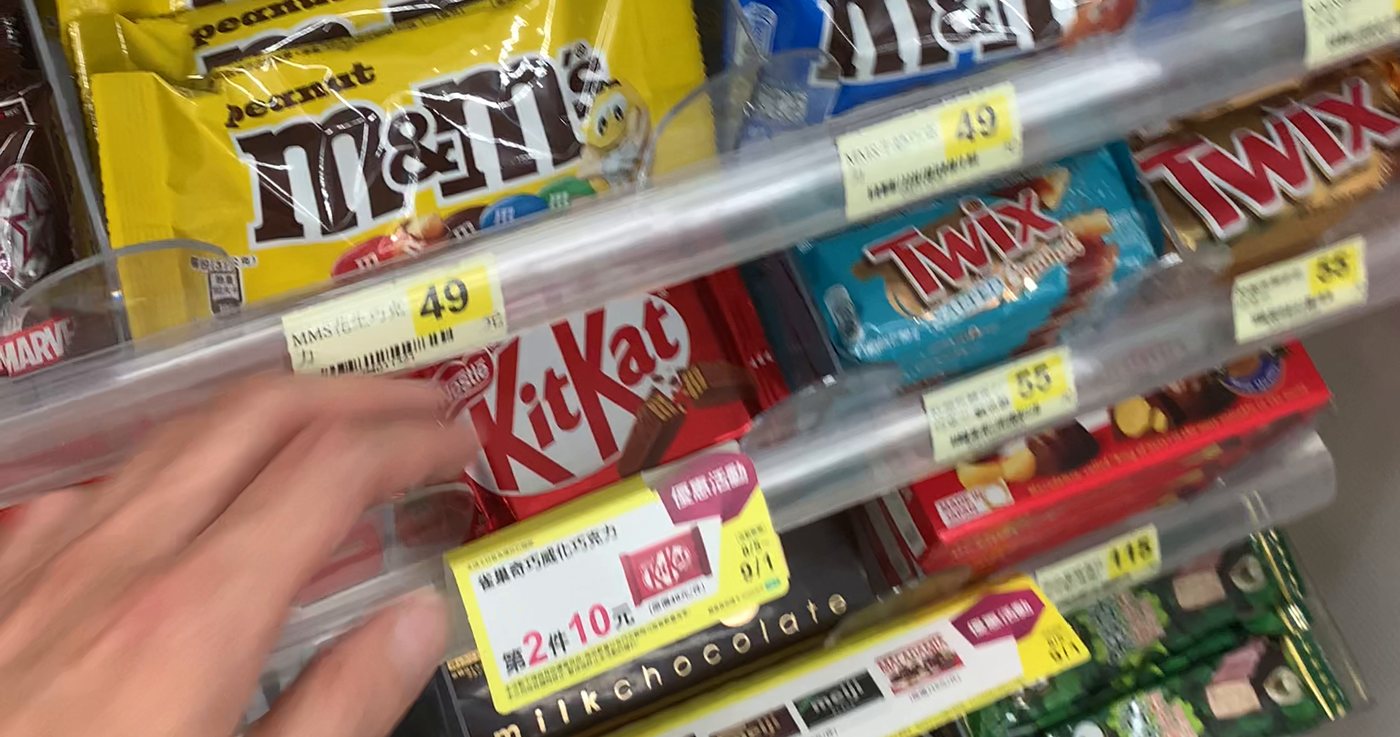
7-Eleven Snack Calories: What a Barcode Scan Actually Tells You
Packaged snacks are the easiest food in the world to count. The number is printed on the back, the portion is fixed, and nobody's grandmother added an extra spoon of oil to it. A convenience-store shelf should be the one place a calorie app has nothing left to do.
Then you scan two of them and find that the snack worth putting back was the one with the lower number.
Two real snacks, scanned at the barcode
| Snack | Calories | Protein | Carbs | Fat |
|---|---|---|---|---|
| Nutella B-ready bar | 115 kcal | 1.6 g | 13.4 g | 5.9 g |
| KitKat bar | 185 kcal | 2 g | 23 g | 9.3 g |
Both figures came off the barcode, not a photo. They cross-check well against published data: Nutella lists a B-ready bar at about 110 calories, and a KitKat runs about 209 for the standard 41.5 g bar, closer to 180 at 35 g. The scan is doing its job.
The one that got stopped was the lighter one
The B-ready bar is 70 calories cheaper than the KitKat. It is also the one that came back with a red banner on it, because the barcode matched an allergen already saved in the profile doing the scanning — tree nuts.
The KitKat went in the basket. The lower-calorie snack went back on the shelf. Nothing about that decision came from the calorie column, and no calorie chart anywhere would have produced it.
The takeaway: for packaged food, calories are the easy question and they are already answered on the label. The useful thing a scan adds is everything beside the calories — the ingredient list, read in full, every time, without you having to turn the packet over in a shop with bad lighting.
Packaged food is the one place a scan is exact
A photo of a plate of food is an estimate, and an honest app says so. Oil, portion size and what is hidden under the rice are all genuinely unknown. That is why the ranges on this site are ranges.
A barcode is different in kind. It resolves to one specific product with a manufacturer's declared nutrition panel and a declared ingredient list. There is no estimating step. If the barcode matches, the numbers are the label's numbers — which is why a convenience-store run is the highest-confidence logging you will do all day, and a night market is the lowest.
Typical Taiwan convenience-store calories
| Item | Typical serving | Calories |
|---|---|---|
| Oden broth, plain (關東煮湯底) | small bowl | ~15 kcal |
| Oden vegetables (daikon, bamboo, mushroom) | per piece | ~7–15 kcal |
| Tea egg (茶葉蛋) | 1 egg | ~75–80 kcal |
| Chocolate bar | 1 bar | ~110–210 kcal |
| Onigiri (御飯糰) | 1 piece | ~180–250 kcal |
| Egg tart | 1 tart | ~210 kcal |
| Steamed pork bun (肉包) | 1 bun | ~260 kcal |
| Egg salad sandwich | 1 pack | ~350 kcal |
| Hot-food bento | 1 box | ~600–700 kcal |
Ranges are typical published figures, not any single store's current SKU. Convenience-store products change constantly, and the packet in your hand always beats a table on a website — including this one.
The cheapest protein in the store is still the tea egg
At roughly 75–80 calories for about 6–7 g of protein, a tea egg does something no bar on the chocolate shelf does. The one thing worth knowing about it is sodium rather than calories: a tea egg carries roughly three times the sodium of a plain boiled egg, because it has been sitting in soy braise all day.
The same footnote applies to oden. The pieces themselves are genuinely light — daikon, bamboo shoot and mushroom are all in single or low double digits — but the broth is where the salt is. Eating the pieces and leaving most of the soup is the version of that meal that behaves the way it looks.
Common questions
Is a barcode scan more accurate than a photo? Yes, materially. A barcode resolves to a declared nutrition panel; a photo has to estimate portion and preparation. Use the barcode whenever a barcode exists.
What if the product isn't in the database? Regional and store-exclusive items are the common gap — Taiwan convenience-store own-brand SKUs turn over fast. When a barcode misses, the label is right there; enter it once and it is saved.
Can an app catch every allergen? No, and no app should claim it. A flag is only as good as the ingredient data behind that specific barcode, and manufacturers reformulate. Treat a flag as a prompt to read the physical packet, never as a substitute for reading it.
Is the lower-calorie snack the better snack? Not automatically, which is the whole point of this page. Calories are one column. Allergens, protein and sodium are three more, and any of them can outrank it.
How Bao handles it
Bao reads the barcode, pulls the declared panel, and checks the ingredient list against the allergies and conditions saved in your profile before it shows you anything. When something matches, the banner comes up on the result screen rather than in a settings page you would never open in a shop. The calorie number is still there. It is just no longer the only thing being checked.
Always confirm against the physical label. The scan is there to catch what you would otherwise skim past, not to replace the packet in your hand.
Stop guessing your macros
Bao gives you honest nutrition estimates for the food you're actually eating.
Download on the App Store